Shadow AI: The Innovation Lab You Didn't Know You Were Running

Your best performer isn't lucky. They're using AI you don't know about. Here's how to turn that hidden risk into your next competitive advantage.

The Sales Rep Who Wouldn't Share Their Secret

Picture this. You're the head of sales and a new hire has crushed their targets in month one. You're ecstatic—you highlight them to the team and want everyone to emulate them.

But the new hire is withdrawn, non-committal. When asked how they did it: "Just lucky, I guess."

Over the next two months, they continue to outperform everyone. You can't take it anymore. When you see them constantly on their phone, you steal a quick peek at their screen.

"What's Claude?" you ask.

That company had two choices: punish the rule-breaker, or promote their thinking. The same choice faces every leader—sooner than you think.

What Is Shadow AI?

Shadow AI is any artificial intelligence tool that employees adopt independently, without IT approval or oversight. From consumer chatbots like ChatGPT and Claude to productivity assistants and coding copilots—it's the AI equivalent of Shadow IT that has plagued organisations for decades.

But there's a critical difference: the stakes are higher.

Shadow IT meant duplicate software subscriptions and integration headaches. Shadow AI means your trade secrets, customer data, and competitive advantages flowing into systems you don't control.

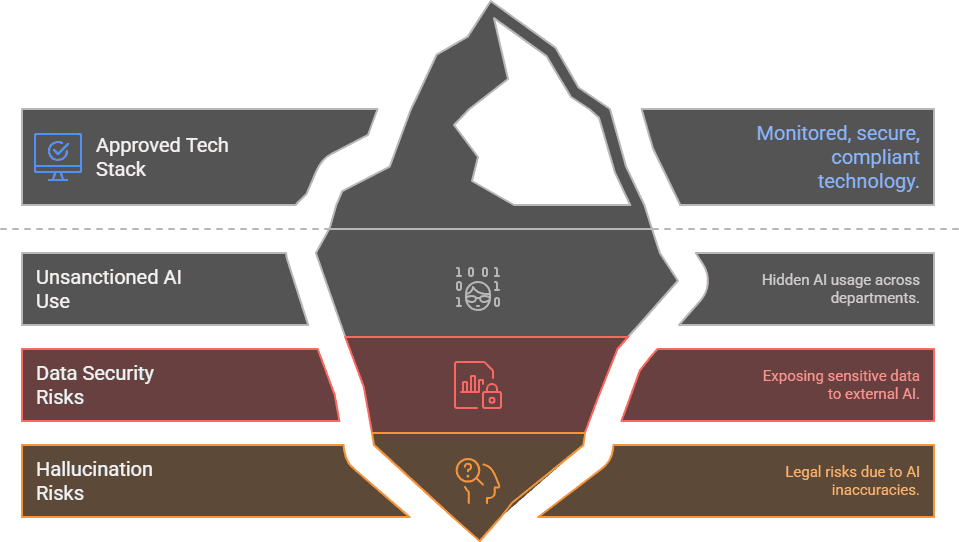
The Iceberg Beneath Your Approved Tech Stack

Above the surface: your approved, monitored, and compliant tech stack. Below: the unsanctioned AI use you can't see.

Shadow AI iceberg diagram showing approved tech stack above the waterline and hidden risks below: unsanctioned AI use, data security risks, and hallucination risks

What's Happening Below the Waterline

  • Your accounts assistant is pasting sensitive financial data into a free ChatGPT account to help with Excel formulas.
  • Your sales team is feeding customer information into Claude to craft proposals faster.
  • Your legal department is experimenting with contract reviews—without understanding hallucination risks.

According to a 2023 Cyberhaven study 11% of content employees paste into AI tools contains confidential or sensitive data. Not 1%. Eleven percent.

The Numbers Your Employees Won't Tell You

The Calypso AI Workplace Study surveyed 1,002 US workers aged 25-65 in 2024. The findings should concern every leader:

52%

would use AI tools regardless of company policy

28%

already using unauthorised AI tools at work

34%

would quit a company that doesn't embrace AI

47%

feel more productive when using AI

Translation: half your workforce is using AI whether you permit it or not.

Three Risks That Can Sink Your Organisation

1. Data Leakage: Once It's Out, It's Gone

Every prompt can contain trade secrets, customer information, or intellectual property. Once submitted to a public AI service, that data becomes potentially irretrievable—and may resurface in other users' responses.

By mid-2023, 65% of the top 20 pharmaceutical companies had banned ChatGPT to prevent R&D secret leakage. Major banks including JPMorgan Chase, Goldman Sachs, and Deutsche Bank followed suit.

2. Compliance Catastrophe: The €15 Million Wake-Up Call

GDPR fines can reach 4% of global annual revenue. One employee pasting personal information into ChatGPT could wipe out years of profit.

In separate actions, US regulators fined major banks over $1 billion collectively for employees using unauthorised messaging apps like WhatsApp that bypassed record-keeping rules. AI tools present identical risks.

3. Truth Decay: When Hallucinations Become "Facts"

AI hallucinations treated as facts can contaminate decisions across your organisation: legal briefs with fictional case law, financial models with fabricated data, strategic plans built on confident-sounding nonsense.

Why Banning AI Doesn't Work

Samsung banned AI after their leaks. It's a natural reaction. But history suggests it's the wrong one.

"I don't believe in prohibition. I don't think it works. The best example is 1920s America. Alcohol was banned to protect society. What actually happened? Speakeasies exploded, moonshine killed thousands, and organised crime thrived. Why? Because you can't ban human nature.

AI is to alcohol as the workplace is to the speakeasy.

Woe betide anyone who gets between a human and the easy route—because that's exactly what AI offers: a path with less friction than before. Your employees will find workarounds. They'll use personal devices. They'll become more secretive, not less.

Remember: 52% said they'd use AI regardless of policy."

— Tristan Day, Founder, Deimos AI, speaking at the Nottingham Digital Summit in September 2025

Reframe: Your Shadow Users Are Tomorrow's Competitive Advantage

What if we've been looking at this wrong?

Every unauthorised AI use is a signal—a message from the coalface saying: "This process is broken. I need help. There must be a better way."

These "rebels" are actually pioneers. They're solving real problems in real time. They're showing you the problem and the solution.

Shadow AI is an innovation lab you didn't know you were running.

Your employees are already experimenting, already learning, already innovating. They're not waiting for permission to explore the future—they're building it. Honda calls this approach Kaizen: continuous improvement.

Will you resist it, or will you roll with it? Can you redirect the momentum to lift your whole organisation forward?

The LIGHT Framework: Govern Shadow AI Without Killing Innovation

The answer isn't prohibition—it's transformation. The LIGHT Framework provides a structured approach to convert shadow AI risk into organisational advantage.

Listen
Survey your workforce anonymously. Find out what AI tools they're using and why. Declare an amnesty where people can share without repercussions. You can't govern what you can't see.
Integrate
Take the best discoveries and integrate them into official toolsets. That sales rep using Claude? Give everyone access—with guardrails. Turn rogue innovation into sanctioned advantage.
Govern
Implement guardrails, not roadblocks. Deploy observability to see usage patterns. Enforce compliance automatically. Filter sensitive data before it leaves. This isn't about control—it's about focus.
Harness
Your shadow users are power users. Harness them as innovation champions. The person who figured out how to use AI for proposals should be training the whole team—not hiding in fear.
Transform
Transform your culture to become AI Forward. Create an environment where experimentation is encouraged through official channels, making shadow AI unnecessary.

The Patterns You'll Spot With Proper Observability

Once you have visibility into AI usage, actionable insights emerge:

Pattern ObservedSmart Response
Same questions asked repeatedly across usersIntroduce prompt templates or a knowledge base
People constantly pasting data into promptsWire up secure data source integrations
Personal information being enteredAdd PII filtering and targeted training
Similar workflows across disparate teamsUnify the process organisation-wide

Moving from Risk to Opportunity

Visibility doesn't just mitigate risk—it reveals where your biggest opportunities for transformation are hiding.

Explore what visibility reveals

The Samsung incidents—two coding assistance cases and one administrative task—today would point directly to solutions: coding copilots like Claude Code or OpenAI Codex with proper controls, and meeting transcription tools with appropriate governance.

But you'll only know that if you're observing usage.

Deimos Nexus: The LIGHT Framework, Deployed

Deimos Nexus is a self-hosted AI observability and orchestration platform that makes the LIGHT Framework operational. Designed for regulated industries and mid-market organisations, it provides governed AI access while maintaining complete visibility and control.

How Nexus Implements Each Principle

Listen
Full observability captures usage patterns across 50+ AI tools. See what your people are actually doing—without surveillance anxiety.
Integrate
Built on OpenWebUI, Ollama, and LiteLLM for model routing. Connect your preferred AI models through a single, governed interface.
Govern
Langfuse integration provides prompt logging and cost tracking. Grafana dashboards surface compliance risks before they become incidents.
Harness
Identify your power users from the data. See which teams have cracked productive workflows worth scaling.
Transform
Self-hosted deployment means your data never leaves your infrastructure. Enterprise-grade governance that regulated industries require.

Enterprise Deployment in 2-4 Weeks

  • Governance alignment: 2-3 days with Legal, InfoSec, and Compliance
  • Platform deployment: 1-2 weeks in your cloud or on-premise environment
  • First insights: Within 30 days of go-live

There's Another Risk: Cognitive Dependency

Beyond shadow use lies a deeper concern—what happens when teams become over-reliant on AI? MIT research reveals the cognitive cost of "AI First" thinking.

Learn about AI-First risks

Frequently Asked Questions About Shadow AI

Shadow AI refers to any AI tool employees use without official approval or IT oversight. You should care because 52% of workers say they'll use AI regardless of company policy, 11% of content pasted into AI tools contains sensitive data, and GDPR fines for violations can reach 4% of global revenue.

Prohibition typically fails. When Samsung banned AI after three data leaks, they stopped the immediate bleeding but lost innovation momentum. Like 1920s alcohol prohibition, banning AI drives usage underground and creates "AI speakeasies" that are harder to monitor. A governance-with-guardrails approach—exemplified by the LIGHT Framework—is more effective.

LIGHT stands for: Listen to your workforce through anonymous surveys; Integrate the best discoveries into official toolsets; Govern with guardrails, not roadblocks; Harness your shadow users as innovation champions; Transform your culture to become AI Forward. It's a structured approach to convert shadow AI risk into competitive advantage.

Your employees are already monitored—email is accessible to admins, calls are recorded for quality purposes. The key is ensuring benefits outweigh perceived oversight. Focus monitoring on patterns and risks (PII detection, repeated inefficient queries) rather than individual surveillance. Transparent policies and visible benefits (better tools, prompt templates, productivity gains) reduce resistance.

"AI First" means using AI before anything else for every task. A June 2025 MIT study showed this approach weakens neural connectivity—creating "cognitive debt." Critically, the study found that when AI access was removed, participants' neural activity did not recover to baseline levels, suggesting persistent cognitive effects. "AI Forward" means AI enhances the human experience without hollowing it out. It augments rather than replaces human thinking, keeping humans in the loop while benefiting from AI capabilities. Read more on our dedicated AI Forward page.

Major incidents include: Samsung's three data leaks in 20 days (April 2023); a UK solicitor referred to the SRA after submitting AI-generated fake case citations to the High Court (June 2025); New York lawyers sanctioned for filing AI-generated fake case citations (June 2023); Google Bard's demo error wiping $100 billion from Alphabet's market cap (February 2023); and the UK exam algorithm that downgraded 39% of A-Level results (2020).

The LIGHT Is in Your Hands

Remember the sales rep who crushed their targets using Claude? Your organisation faces the same choice: punish innovation, or channel it.

Your employees are already building the future—with or without you. The question is whether you'll lead the transformation or be disrupted by it.

Book a call to discuss how Deimos Nexus can bring governed AI to your organisation in 2-4 weeks.